Pages

Thursday, July 7, 2016

Types of Knowledge Within a Personal Learning Network

Originally posted as a response to Downes's Mental Models I Find Repeatedly Useful.

"...a carpenter has an understanding that goes beyond the tools...This, not the tools, makes a carpenter."

A carpenter comes to my house and makes claims of her craft, articulating a comprehensive understanding of principles related to her profession.  But after beginning the job,  it is apparent that she lacks the tools necessary to bring about this understanding in the form of evidence.  

The tools are never more important than one's understanding (knowledge, etc.), but they are necessary in reifying an understanding.   That is, knowledge, understanding, etc. are not more important than the materials, objects, technologies, etc. used to demonstrate such knowledge, etc...what is more important is understanding the (synchronic/diachronic) associations between the ideational, material, and social relationships that exist around a particular domain, event, or circumstance.  

How relevant is a knowledgable carpenter who is unable to perform (because of a lack of tools) than one who has no knowledge at all.  Ideas (including declarative knowledge), materials, and social relationships (aka a personal learning network) together bring about tacit knowledge.  To understand any one of them is to understand how the other two form a single (synchronic/diachronic) aggregate. 

It is hard to see how an understanding can ever go beyond the tool.  Artificially, I can see how some might view formal education through the use of quizzes and standardized tests as measuring declarative knowledge in the absence of tacit knowledge (practical skills), where perhaps one could admit that understandings go beyond the tool, but I would not put much weight behind this argument. 

Finally, I can see when one might find clever ways to use simpler or more antiquated technologies to become more effective, efficient, and engaged, but one's understanding is not going beyond the tool.  Instead, this is just an example of understanding ideational, material, and social relationships within a particular context.  Conversely, a teacher who has a traditional ideology related to teaching and learning (which creates inefficiencies, etc.) but uses different kinds of technology in his practice is just demonstrating a lack of understanding between the ideational, material, and social relationships that help define the situation.  It is not a misunderstanding of the technology, course content, or interactional pattern(s) as separate entities, but rather how these three come together and how they influence one another.

Curious how others feel.  When do declarative knowledge, understandings, etc. go beyond the tool?

Saturday, July 2, 2016

A Connectivist Story About Gratitude


Below is a story involving my son, which also serves as a text I plan to use for a future composition course where we discuss the differences between academic and creative writing...

I talked to Beny on the phone yesterday afternoon as he explained how he had slipped on the stairs walking up to his seat at the Cinepolis movie theatre in Altaria (Aguascalientes). While he was telling me the story, taking it all in stride, I could see how it might have been a little embarrassing, having this happen in a public place while celebrating the last day of school with three pals from school.  Later did I find out the whole story...

After performing a common ritual of securing soda and popcorn, Beny was walking up a poorly lit stairway before getting tripped up and losing his grip around snacks that he has come to enjoy while watching the opening credits to his favorite movies - yeah, food rarely has a chance of surviving the opening lines of any given film.  As he sat on the stairs trying to gather himself, his pals could hardly contain themselves.  The subsequent 30 seconds that it actually took to pick up after himself and move on to his assigned seat had to feel more like several minutes as slow motion seems to enjoy dragging out embarrassing moments for full effect.  For the next 10 minutes (about the time we spoke on the phone), his crew continued to recall the moment, each having a particular vantage point in recollecting what had happened.  I image it being something like a variation on a theme of the humiliated.  Suddenly, out of nowhere, a perfect stranger approached Beny and his posse and went on to share a similar story of her also falling down the stairs, much in the same way that he had just experienced.  Unbeknownst to Beny, the lady had immediately posted to facebook what had happened, and within minutes the Cinepolis manager on duty had replied to the post, expressing that the boy could find her in order to get a free refill. The good Samaritan passed along the news to Beny, and well, all ended well.

This story is about gratitude more than anything else and how technology offers affordances to individuals who find fulfillment in helping someone else without thinking twice.  In this case, the end result was trivial; however, the chain of events that reached the end result remains the true lesson.  Although Beny thanked all of those involved at the time, he later never found the post in facebook so to extend his gratitude.  But by sharing his story, our "posse" gets to reflect on how empathizing with others leads to actually taking action on someone else's behalf.

Beny has read this post and has given me permission to share his story with others.  I wasn't sure how open he would be about me sharing his experience, but was relieved to find out that he had awarded me a 10 (an A+) for my efforts. I thought the issue might be about inaccuracies of what had transpired, my perspective, or simply not wanting to rehash what had happened, but he seemed to be especially surprised that I even had an ability to put ideas together in the form of a written text (admittedly, others may still not be convinced).  Regardless, what’s a story if it can’t be shared?  #cinepolis #gooddeeds

The Flipped Classroom and Personal Learning Networks

[youtube https://www.youtube.com/watch?v=-AMaE1_REiU]

My final post for #openflip Spring 2016 includes discussing the fourth facet of a flipped classroom: a personal learning network (PLN).

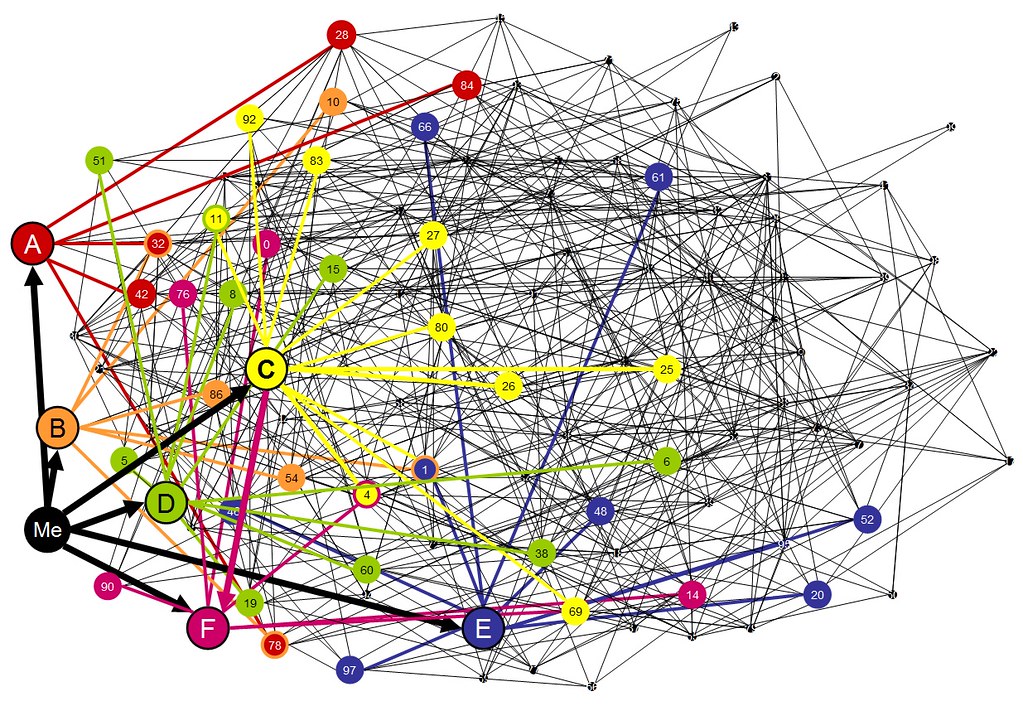
Professional learning is to become self-aware of one´s personal learning network in how it contributes to a particular experience. A PLN is having the self-knowledge of how learning spaces, groups and networks, and all forms of learning come together at any particular moment and how they adopt and adapt over time. A PLN is about understanding ideas (beliefs, opinions, thoughts, etc.), materials (objects, technologies, etc.), and human relationships (uni/bidirectional communication, strong and weak ties, etc.) not as isolated notions, but as associations that are influenced by each other. In a flipped classroom scenario, a learning network can be viewed at any level: individual, pairs, small groups, whole class, domains, institution, district, community, global, etc., but what makes a PLN personal is that the power and prestige (from a network and not a sociological perspective) are revealed through the understanding of how all ideational, material, and human nodes connect and surround the individual (e.g., student, teacher, etc.). Thus, the individual remains the unit of analysis but cannot be taken out of context. Understanding a PLN (i.e., a learning network at the individual level) becomes a prerequisite for understanding a learning network at the group level, for instance. Understanding a learning network at the classroom network is to understand the learning networks of various groups, pairs, and individuals, etc. Within the context of formal education, an educator has a responsibility in bringing about awareness of student PLNs as well as one´s own PLN. An expert learner is one who has a high level of self-awareness of a purposeful PLN at any given time and how it adopts and adapts over time - a PLN is at the heart of understanding what a flipped classroom is; how it is employed; and how effective, efficient, and engaging it can be for both learner and educator. In order to become adept, one needs to adopt and adapt a PLN.

Wednesday, June 22, 2016

Flipped Classroom: Intentional vs. Incidental Learning

[youtube https://www.youtube.com/watch?v=oFN1ETGNJAE]

After watching OpenFlip Spring 2016 Week Three (noon edition) (#openflip, #flipclass), I quickly began feeling lost at the notion of "intentional content" and it´s relevance in the flipped classroom.  I actually did not disagree with anything mentioned in the video, except when the term intentional content was mentioned, which would lead to a "what are we talking about" moment.  The group discussion quickly forced me to revisit what others said about the third pillar of the flipped classroom (internet search), and then try to relate it to what Ken and others were discussing today...and I think I have it.  Just for the record, my discussion about intentional learning vs. incidental learning was recorded yesterday, before having listened to today's talk. Now, let´s unpack the term, intentional content.

Several definitions around the notion of intentional content seem possible.

  1. Predetermined (or prepackaged) content available outside of class that serves as input that enables learners to take subsequent syllabus-aligned action.
  2. Predetermined (or prepackaged) content available outside of class that serves as input that enables learners to take subsequent non-syllabus-aligned action.
  3. Predetermined (or prepackaged) content available in class that serves as input that enables learners to take subsequent syllabus-aligned action.
  4. Predetermined (or prepackaged) content available in class that serves as input that enables learners to take subsequent non-syllabus aligned action.
  5. Student-created content made available outside of class that is a result of syllabus-aligned action.
  6. Student-created content made available inside of class that is a result of syllabus-aligned action.
  7. Student-created content made available outside of class that is a result of non-syllabus-aligned action.
  8. Student-created content made available inside of class that is a result of non-syllabus-aligned action.
At first glance, one might argue that intentional content is only that which is found outside the classroom.  But in practice, I do not think it is a stretch to image predetermined content beginning the learning process outside of class, then to a certain degree subsequently being part of an educative experience in class. Even in the case of student-created content, if the teacher permits such content to be produced, then there is still a level of intentionality to the process.  Thus, the eight definitions above are all possible when considering what is intentional content, intentional on the part of the educator and not the curriculum.  For this reason, the third pillar (intentional content), seems arbitrary.

In my wiki, I modified the third pillar to my own third facet of the flipped classroom: intentional and incidental learning.

In the eight definitions above, definitions 1, 3, 5, and 6 relate more to intentional learning while definitions 2, 4, 7, and 8 relate more to incidental learning.  Additionally, definitions 1-4 could also include incidental or emergent content as well (as opposed to predetermined content) which brings another level of complexity to the mix - a complexity that I think is also very relevant to the flipped classroom. 

Changing from intentional content to intentional/incidental learning puts more focus on learning by doing and is more pertinent to the idea of flipped the classroom.  Content as input is secondary since 1) the degree to which it enables action highly depends on the individual learner and the particular context and 2) the enabled action really depends on whether an educator can bring both intentional and incidental learning together to meet both curricular and individual goals; when it comes to content creation, the action (intentional/incidental learning) is typically more relevant than any preconceived notion of student-created content.  If student-created content is equally or more important than the learning process, I would question whether or not this falls within the four facets (or pillars) of a flipped classroom.


Wednesday, June 15, 2016

Flipped Classroom: Learning Community

[youtube https://www.youtube.com/watch?v=dRnI24OQBqo]
This week I share my current thoughts on creating a learning community within the flipped classroom (#openflip, #flipclass)...
A learning community stems from both student collaboration and student cooperation. Student collaboration focuses more on the we, and centers around having common goals and best practices. Collaboration requires participants reaching a consensus in how they work together and to what end. The downside to student collaboration is possible coercion. In contrast, student cooperation focuses more on the I, and is the assigning of individual responsibility around a particular task based on one's individual interests, strengthens, and background; then managing those individual interests, strengths, and backgrounds as a collective whole. When students cooperate, there may be a common goal that brings people together, but individual goals take precedent. A possible downside might include individuals putting self-interests over helping others. If the goal is helping learners become more interdependent, then student cooperation has certain advantages over student collaboration. Regardless, both have advantages and potential drawbacks, and both can be incorporated into the overall educative experience so that students learn to work in different ways.
From a pedagogical standpoint, educators need empathy, perspective, and metacognitive strategies to rallying together enough educational stakeholders to promote an open and engaging learning community.

Flexible Learning Spaces

[youtube https://www.youtube.com/watch?v=MDOf5h2zn1w]

As we enter week one of #OpenFlip Spring 2016, I thought I would create a wiki about my thoughts regarding the four pillars (I call them the four facets) of the flipped classroom.  Under its current (rough) form, it offers a slight variation from teachthought's (2014) version, and likely will undergo several more changes as I continue to reflect on the subject over the next few weeks.  Currently, I have this to say about what I refer to as flexible learning spaces:

Flexible learning spaces relate to one of the four aspects of differentiated instruction: learning environment. Differentiating learning environments offers flexibility to learners as to when and where the educative experience might take place. As with any educational setting, the role of the educator in offering such flexibility comes from being a didactic leader (learner as dependent), facilitator (learner as independent), and coach (learner as interdependent). Thus, the value in thinking in terms of flexible learning spaces comes from the degree with which learners become aware of how these spaces facilitate the learning process, creation of products, and retrieval and creation of content based on a set of educational and personal learning objectives. Within a formal education context, the teacher-student relationship exists from having a perpetual feedback loop that is reciprocal and iterative that over time takes the learner from being dependent, to independent, to finally interdependent. With flexible learning spaces this process becomes more ubiquitous.


In a flipped classroom, having flexible learning spaces is using physical and online educational resources in a way that offers the greatest chance for student achievement.
Thus, I attempt to...

  • provide options for flexible learning spaces and time frames that set out to facilitate engagement and reflection.
  • provide ample amounts of formative assessment that periodically (not continuously) leads to adjustments to instruction and adjustments to learning tactics as required.
  • differentiate product, process, content, and learning spaces collectively as needed in order to help learners become more interdependent.   

Sunday, May 29, 2016

OpenFlip Spring 2016 Course

[youtube https://www.youtube.com/watch?v=PeelKOWCy-s]

Just signed up for OpenFlip Spring 2016, #openflip.  Will be thinking about this infograph throughout.

Flipped Classroom
Created by Knewton

Wednesday, May 4, 2016

Prescribed Outcomes in Formal Education

Attribution
Today I came across an image entitled, Types of Student Inquiry, which sparked a Twitter exchange around the notion of prescribed outcomes. I would like to dig a bit deeper into the idea of prescribed outcomes, specifically within the context of formal education.  By formal education, I simply mean teaching and learning that occurs in schools which follow some form of written, taught, and tested curriculum.  This argument does not hold up to informal learning contexts.  My Twitter exchange with Sanchez is more related to what is meant by the term prescribed outcomes and less about educational philosophy; having followed her for some time, I can say we agree on most things when it comes to education.  My argument here has more to do with how others might interpret the idea of inquiry as it relates to their own local practice.

My initial reaction to the types of student inquiry related to the small degree of difference between structured, controlled, and guided inquiry, followed by an enormous jump from guided to free inquiry.  The differences that I am referring to have to do with transitioning learners from being dependent, to independent, to finally becoming more interdependent (You can find more about this by searching interdependent in this blog).  But what stood out the most from these different types of student inquiry was the definition of free inquiry:
Students choose their topics without reference to any prescribed outcome.
After a few Twitter transactions, Sanchez suggested that students, "first come up with ideas & the topic which are approved [by] the teacher but they still choose". (Emphasis added.)

So, one could argue that giving students opportunities to choose about what and how they are learning aligns with the definition of free inquiry based on the definition above.  It sounds logical that letting students decide is equivalent to freeing up the inquiry process. But looking at the underlined part of the definition is what is in question: ...without reference to any prescribed outcome.

When teaching grammar, language educators typically have two approaches: teaching grammar prescriptively and teaching grammar descriptively.  Teaching prescriptively is about making a clear distinction as to what is correct or incorrect when it comes to grammar.  In contrast, teaching descriptively has more to do with teaching or learning grammar based on how it is currently being used within a particular speech community.  An example might include the subjunctive verb, were.
(Prescriptive grammar): I wish I were a millionaire...This is the correct use of the verb were and saying I wish I was a millionaire... is incorrect.
(Descriptive grammar): I wish I was a millionaire...Using was in this case is commonly used in songs, poetry, and common day-to-day interactions in both formal and informal situations, and therefore is acceptable.    
Just as a doctor prescribes medicine or a way of life to a patient who is ill, a teacher at some point "prescribes" an outcome, process, product, or content to a student who is experiencing a gap in knowledge and/or skill sets.  The word prescribe within the context of this post relates to a ¨correct or incorrect¨assessment of outcomes to a given set of desired results (e.g., the curriculum).  Agreed, feedback can be qualitative or quantitative, but in formal education, a student typically either passes or does not pass a class.

Sanchez states, "The image doesn't say students do whatever it says no prescribed outcomes".

If teachers agree that students can choose topics but should be approved by teachers, then the approval process must be based on criteria or a set of standards that all students must follow.  The criteria are usually related to (or based on) outcomes, products, processes, and content.  The criteria are the expectations the students should meet based in large part on the curriculum, and are reflected in the outcomes, etc.  This does not mean that students have no input or may not make any decisions on the outcomes, product, process, or content, but there are expectations that students must meet, and these expectations impact the expected outcomes students are to pursue.

Now, one could argue that teachers may not dictate these outcomes, products, processes, or content before the learning sequence, but the learning objectives are (or should be) determined beforehand.  Outcomes that align with learning objectives can emerge (inductive learning) or they can be shared beforehand (deductive learning);  they can be implicit or explicit. Regardless, at some point outcomes must adhere to standards that will be assessed based on the curriculum.  And because instruction and (formative) assessment are so closely intertwined, topics students discuss must (at some point) be referenced to some prescribed outcome.  This can happen without specifying how the outcome was determined (or by whom) or when throughout the learning sequence the outcome is determined.

As a side note, the act of inquiry is part of an overall learning sequence that likely will also include collaboration, cooperation, creation, etc., so saying that free inquiry has no reference to any prescribed outcome could lead some to believe that outcomes are completely separate from the inquiry process.  It seems logical to believe that the inquiry process (regardless of kind) would also consider various kinds of outcomes.

If students are to receive a grade, or fail/pass marks, then at some point student outcomes become prescribed to the degree that outcomes meet or fail to meet some level of criteria or set of standards that align with a curriculum.  Without such criteria, student outcomes would take on any form.  Having prescribed outcomes simply means that expectations about those outcomes have been communicated, discussed, negotiated, etc., between teachers and all learners.

What are your thoughts about inquiry?  Agree or disagree with my argument?

Sunday, March 13, 2016

Personalized Learning vs. A Personal Learning Network Awareness

Attribution
I read What is Personalized Learning, and I agree with several things about the overall post, most importantly the opening sentence...Words matter.  This post came after an earlier post of mine which countered the term "personalized learning".  As a result, I feel I need to address this again since there are a few points in yesterday's post that I take issue with.  My ideas are not totally inconsistent with what Downes mentions in his piece, Personal and Personalized Learning, well worth the read, but will attempt to take a slightly different angle.

Philosophical Analysis

Let's first take a look at the use of the term, personalized, which is defined generally, outside the context of education.
to design or tailor to meet an individual's specifications, needs or preferences: a personalized search engine (dictionary.com).
We often hear of companies personalizing objects, software, materials, computers, etc. for other companies, which is clearly an appropriate use of the term...to a point.

I used to work for a university who contracted a company to design an accounting software system which was said to be "personalized" based on certain criteria dictated by the institution.  When it came to implementation however, there were many cases where the "personalized" accounting software failed to meet the needs or preferences of the user.  Now, in all honesty, personalizing any accounting software to the needs and preferences of every user within an organization is indeed an impossible task.

Let's look at two attempts to transfer the notion of personalized learning to education.
Tailoring learning for each student's strengths, needs and interests - including enabling student voice and choice in what, how, when and where they learn - to provide flexibility and supports to ensure mastery of the highest standards possible (iNACOL).
"Tailoring" is not the same as "personalizing".  Tailoring instruction and assessment as been mentioned at length in Wiggins and McTighe's (2005) Understanding by Design, and is quite different than "personalizing" something, which in education, is impossible frankly. More on this later.
Buckley's attempt at personalized learning brings together "personalisation for the learner" and "personalisation by the learner" (Wikipedia). 
Buckley is on to something, but using the word, personalization, gets in the way.  Let's analyze.

Personal Learning Network

For the purposes of this discussion, I will use the term personal learning network (PLN) to mean any and all associations between 1) ideas, beliefs, thoughts, concepts, etc.; 2) materials, objects, technologies, etc.; and 3) human relationships.  A PLN will also be used instead of the notion of a personal learning environment; the former again will include ideational, material, and human nodes in their aggregate, both as they exist at any given moment and/or how they morph, create, and deplete over time.

Without a doubt, teachers are huge factors in how students use their PLN for the purposes of achieving course and personal objects within a formal education context.  But a PLN never begins from nothing and changes into something.  It always has and always will exist, for better or for worse.  Learning is a particular change in one's PLN for a particular purpose (whether intentional or incidental), usually allowing one to either be able to do something new or to realize a new perspective (i.e., to think differently).

To personalize a learning experience for a learner would mean having some god-like ability to control every possible (ideational, material, and human) node configuration that came directly (one degree of separation) or indirectly (two or more degrees of separation) in contact with the individual.  Impossible.  If we look at Buckley's "personalisation by the learner", this would mean that the learner is beginning (presumably from nothing) to personalize (or control) every aspect of ideational, material, and human nodes that came directly and indirectly with the person.  Again, not possible.

The term personalized learning is not needed in education when referring to teaching and learning because we already have more accurate terms already available in the literature.

Critique

What follows is a counter to What is Personalized Learning?
Tailoring learning for each student’s strengths, needs and interests–including enabling student voice and choice in what, how, when and where they learn–to provide flexibility and supports to ensure mastery of the highest standards possible.
I do not think tailoring is the same as personalizing.  Differentiated instruction is a clearer term that means the same as this definition, except for the focus on students' strengths.  It seems negligent to ignore differentiating content, process, product, and environments based also on students' weaknesses.  
Personalized learning includes the idea of connectivism... In personalized learning environments, educators seek to meet each student within their own zone of proximal development.
This is the first time I have ever witnessed someone attempt to connect #connectivism with a cognitivist idea - the zone of proximal development (ZPD), a concept belonging to the Vygotsky's sociocultural camp.  The ZPD actually is another reason why personalized learning falls short.  The problem with using ZPD is that it is impossible to accurately determine the ZPD of any one individual (either at a given point of time or over time), let alone a group of 20+ students in a particular class.  Likewise, it is impossible to determine what a learner can truly do on her own, and what she can do with the assistance of a more capable other (e.g., teacher or classmate).  The ZPD also fails when explaining how students learn by helping less capable others (e.g., reciprocal teaching).

Differentiated Instruction

Practitioners mentioned different components of personalization (differentiated instruction, student agency, flexible pacing, etc,), but differentiated instruction really covers most of these components.  Differentiating content, process, product, and environment pretty much covers it.  Giving students agency, (democratic education), giving them a voice, etc., allows them to take responsibility of their own learning.  If we just removed personalized learning from the discourse, a more accurate discussion could be made on how to create educative experiences for the active learner.

Buckley was on to something though if he just had worded it a bit differently.  Instead of bringing together "personalisation for the learner" and "personalisation by the learner", the job of the educator is to bring better awareness among their learners of their respective PLNs as they pertain to specific contexts, conditions, and purposes so that learner can transition from being dependent, to independent, to later being interdependent. This has nothing to do with personalization, and has everything to do with having the metacognitive skills and insight to cultivate a (ideational, material, and human) nodal collective that best serves the individual and society at large.  It appears that Buckley was all about awareness building, but I would frame it as a PLN as opposed to personalized learning.

Words do matter.  Conflating words like connectivism and ZPD when trying to justify "personalized learning", seems to cloud the issue.  No need to add yet another buzzword when we have plenty that currently exist in the literature that say the same thing in a much more unified, coherent, and cohesive way: differentiated instruction, understanding by design, paideia seminar, greater awareness of one's personal learning network, problem-based learning, task-based learning, content and academic language learning approach, sheltered-instruction operation protocol, content and language integrated learning, etc.

Personalized learning already exists, and has always existed simply because each individual is unique.  Each person already has a PLN, for better or for worse, whether the individual is aware of its potential or not, even if the educator never differentiates instruction whatsoever.  Each learner will experience the exact same situation and subsequent situations differently, even if told to do the exact same thing.  To personalize anything requires using past experiences and current understandings (which are unique to the individual) to link the known with the unknown.

In order to link the known with the unknown (i.e., learning), educators can help learners better cultivate their (already existing) PLN for a particular purpose.  Educators and students alike are making decisions throughout this awareness process, but it is not personalized learning.  Learning happens at both a cognitive and metacognitive level, through constant "tweaking" of monitoring of learning and making inferences based on empirical (observational) data.  It´s messy...it´s simple, yet complex.  Personalized learning is not dichotomous (all or nothing), but rather inherent in the individual learner (for better or for worse) regardless what happens in the outside world.

I can agree with many concepts that others associate with when linking these concepts with personalized learning, without agreeing with the term itself.  I have done the same with the term massive open online course (MOOC) as well. If one feels compelled to use the term personalized learning, envision how it would look in practice and then thoughtfully distinguish this term (empirically) with concepts that already existent in the literature.

What have I missed?  Looking at the pragmatics of teaching and learning, what does personalized learning add to the discourse that hasn't already been said?  

Wednesday, March 9, 2016

"Personalized Learning", an ambiguous buzzword that should mean something

Attribtion

Just read Personalized Learning: People, Practices, and Products, and basically feel the same about the term personalized learning as I did when I wrote Personalization and Personal Learning Networks. But I would add the following...

Learning can't help but be personalized. No two individuals learn anything exactly the same way. Thus, "personalized learning" is the same as "learning".  I cannot personalize a learning experience on a student because I only have a limited amount of control over all of the possible factors that could become part of a student's learning process. Similarly, I cannot personalize my own learning because that would mean that at some point it was not personalized or was in some degree less personalized - impossible. Whatever I do to learn anything is inherently and totally personalized and is no indication of learning effectiveness, efficiency, nor engagement. The use of the term "personalized learning" is like saying, "We should teach based on the learning styles of the students." - another impossible task. The content itself and the reason for having students interact with that content (not the students themselves) determine which learning styles (or multiple intelligences) are most appropriate.
Share your thoughts!  Do you agree?  Disagree?  How do educators personalize learning and how is this similar or different from the notion of differentiated instruction?  How can students make their own learning more personalized?  How is this similar or different from autonomous learning?